

Penni Allen is the clinical coordinator, or head nurse, for the Rockbridge County School District. She and the other nurses in the district started calculating students’ body mass indexes five or six years ago. Body mass index, or BMI, is a rough measure of body fat percentage, and the data the nurses collected were used in applications for health and physical education grants for the schools.
But when Allen sent letters home to parents informing them of their child’s BMI, she never expected the backlash.
“Parents were really angry because they said I was telling them their kids were fat,” Allen said. “So that did not go over so well.”
Parents called to tell Allen the “fat letters” had upset their children.
“I had one parent, she said her child quit eating at school because of that letter,” Allen said. “So I was trying to go check on him and make sure he was eating.”
Allen and her colleagues had reason to be concerned about BMI. Good nutrition, regular physical activity and a healthy body weight can reduce a person’s risk for developing heart disease and other health conditions, according to organizations such as the federal Centers for Disease Control and Prevention.
On the flip side, being overweight or obese has both immediate and potentially long-term effects on a person’s health, according to the CDC.
In 2010, two thirds of the adults in Rockbridge County were overweight or obese, according to the Rockbridge Area Community Health Needs Assessment, a survey spearheaded by the Rockbridge Area Health Center in 2012. In all, 37 percent of county adults were overweight and 31 percent were obese.
Obesity doesn’t discriminate by age; it’s a problem for some children in the area, too. Obesity puts children at increased risk of developing conditions, including high cholesterol, that can lead to cardiovascular disease, prediabetes and bone and joint problems, according to the CDC.
There are about 16 students in the Rockbridge County School District with diabetes, Allen said. And the number of children with type 2 diabetes, which can be caused by both genetics and diet and exercise habits, has been on the rise.
Diabetes affects older members of the local population as well. From 2006 to 2010, on average, 9.1 percent of adults in Rockbridge County had the disease, according to the community health needs assessment. In Buena Vista, 8.9 percent of the population had diabetes, and the number was 9.4 percent in Lexington. All of those percentages are sharply higher than the national benchmark for that same period — 6.5 percent.
Schools step in
In Rockbridge County, one of the biggest players in the fight against obesity is the public school system. But sometimes even the influence of teachers, school nurses and guidance counselors isn’t enough to effectively overcome local cultural hurdles that can stand in the way of developing healthy habits.
In the Rockbridge area, 38 percent of the population lives below 200 percent of the federal poverty level, according to the community health needs assessment. Two hundred percent of the federal poverty level is $22,340 in annual income for an individual and $46,100 for a family of four.
When a person is struggling to get by financially, nutrition might not be a primary concern.
The letters Allen sent to all of the parents in the Rockbridge County School District contained their child’s BMI, as well as averages for each school in the district. The letters also included information about BMI percentiles, which are used to determine whether a child is overweight or obese.
But because of the negative response the school stopped sending home specific BMI information. Instead, parents get a letter containing school BMI averages and are told that they can call and request their child’s BMI information if they would like to see it. Not many parents do. Allen said the year the school started sending out the general BMI information letters, only about 10 parents in the district called to learn more.
In the nine years that Allen has been with the district, she’s worked to make students, staff and parents aware of the importance of healthy eating and exercise habits, and of the resources available locally to help residents achieve healthier lifestyles.
Allen has worked with the district’s Student Health Advisory Board to remove sodas and “bad snacks” from high school vending machines, ensure that students in elementary and middle school have physical education class every day, and offer some mental health programming at the high school.
Those and other initiatives might just be paying off. By one measure, the percentage of overweight and obese children in the Rockbridge County School District decreased markedly from 2010 to 2011.
According to data from the community health needs assessment, 42 percent of Rockbridge County elementary students were overweight or obese in 2010, as well as 47 percent of middle school children and 50 percent of high schoolers. Just a year later, those numbers dropped to just 11 percent of elementary students, 25 percent of middle school students and 37 percent of high school students in the district, although the middle school number jumped to 35 percent a year later.
Allen said she and the other nurses in the district used the same methodology to calculate the BMIs both years, and the community health assessment used those numbers.
“Nobody really is aware of what has made the difference, but something has worked,” said Allen. She was just as surprised as everyone else to see such a drop.
The Buena Vista City School District has also taken steps to promote health and wellness among its students. The district has a “Local Wellness Policy” on its website, which includes sections on nutrition and physical education. Examples of Buena Vista wellness policies include encouraging parents to eat lunch with their children at school and discouraging teachers from taking away a student’s physical education time as a form of punishment, according to the document.
The evolution of school lunches

Changes to the Rockbridge County School District’s meal programs are another factor that might have contributed to the decrease in the number of overweight and obese students.
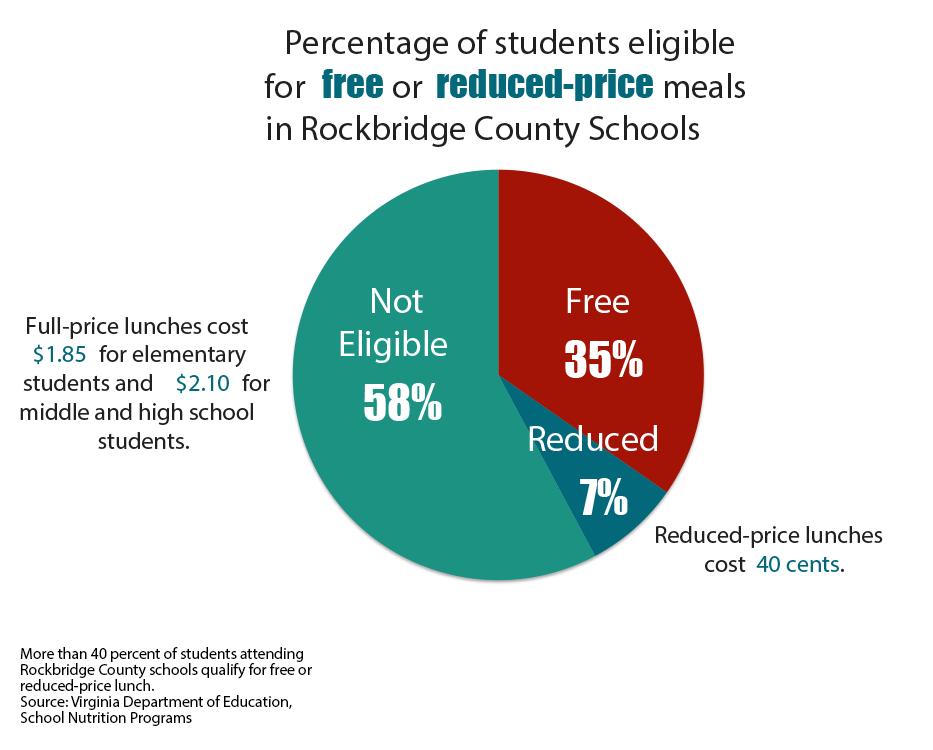
Daphne Stickley, supervisor of food services for Rockbridge County schools, plans breakfasts, lunches and snacks for children in a district where 42 percent of students are eligible for free and reduced-price meals.
Free and reduced-price school meals are made possible through a federal school nutrition program, which sets income guidelines to determine student eligibility. But with federal reimbursements come federal nutrition requirements. The meals that Stickley plans must meet a series of guidelines that include calorie, saturated fat and sodium limits. Updated, more stringent guidelines began going into effect this school year. Stickley said the overhaul was major.
“With all the changes that we’ve made to the menus and how we can serve them — what we can serve in a particular week — that’s huge. I mean, that’s the biggest thing that’s happened to school nutrition since I’ve been involved with it for 26 years,” she said. Stickley said she thinks that the updated guidelines are a good idea, despite the challenges they present to food service staff.
“We are about educating, and offering food that doesn’t meet healthy guidelines is not teaching [students] the right way to eat,” she said.

Federal meal program dollars can be stretched only so far, and the school district does not allocate any of its budget to supporting the food services program. The program must be self-sustaining and get by on federal reimbursements and money made from food sales.
“I’m sure that we’re not doing as much as a lot of people would like us to do, but people need to understand that the money’s got to be there …. We have to make the money in order to spend it,” Stickley said.
Parents can also pack lunches for their children to take to school. When Spencer and Elizabeth Kohl sent their daughter Meredith to kindergarten at Central Elementary in the Rockbridge County district, they packed Meredith’s lunch every day and would sometimes stop by the school to eat with her.
The Kohls, who are farmers, said Meredith was one of the only kindergarten students with a packed lunch. Sometimes other kids would laugh at Meredith’s homemade sushi rolls or sandwiches.
When they would have lunch at the school, the Kohls said, they noticed a lot of children throwing away the fruits and vegetables that were on their lunch trays.
Stickley said she struggles with putting foods on the menu that both meet federal guidelines and appeal to children’s tastes. She said part of the problem is that children aren’t seeing certain healthier foods — such as whole-wheat rolls and chicken breasts — on the table at home, so they aren’t as willing to try those new items at school.
 Time and money are two factors that can influence the nutritional quality of the food that parents serve their children, Stickley said.
“If a person is working two jobs just to be able to feed and clothe their family and have a place to stay, there’s not a whole lot of time sometimes to do everything else,” she said. “Feeding sometimes is like an afterthought.”
Jane Blosser, a registered dietician who works for Augusta Health, said she thinks another barrier that prevents some people from eating healthily is a general lack of cooking skills.
Healthy eating and adults
Healthy eating habits aren’t just beneficial for children. Adults can improve their health and stave off disease with the aid of a healthy diet.
Good nutrition can help a person in the fight against almost any illness, Blosser said. But she said the reverse is also true — poor nutrition can make dealing with many diseases worse.

Blosser estimated that about 25 to 30 percent of the patients she sees are from Rockbridge County, but that transportation to Staunton, where her office is located, can be a problem for some of them. Getting time off work to meet with Blosser can also be a challenge.
The task Blosser faces is convincing people to change eating and exercise habits that they have held for most of their lives. She said she tries to take a personalized approach to helping each of her patients, and sometimes even talks with a patient’s family members to get them on board.
The Rockbridge County School District has made efforts to change the eating and exercise habits of teachers so that they can serve as health role models for students. For example, Allen said, teachers aren’t supposed to have soda at their desks anymore.
Blosser, Allen and Stickley agree that a push for change can’t come only from the health care community and the government. A significant part of the problem involves cultural perceptions and priorities.
“I think that when more people farmed and grew a lot, kids ate so much more of what we’re trying to get people to go back to now,” Stickley said. “I think that makes a difference, because in Rockbridge County we have all this land, but not a lot of people are actually still growing things in their gardens and fixing it for their kids.”
But how do you alter eating habits? Blosser said that problem can’t be fixed with legislation. That’s where the schools, the registered dieticians and community organizations such as the YMCA come into play.
Blosser said she thinks it is possible to change cultural nutrition norms, especially if people have family members or some other type of support system encouraging them.
“It’s really a culture change and it’s hard — I don’t even pretend to think it’s not hard,” she said. “But then, you can have your cake and eat it too if you learn how to do it creatively.”
Alysan Raymond, executive director/CEO at the Rockbridge Area YMCA, said the organization offers educational programming for people of all ages about nutrition and physical activity. Some opportunities include a free diabetes workshop that was offered in the fall and the 59 group exercise classes offered at the YMCA each week, many of which are geared toward older adults.
“I think we’re on the cusp of people realizing that they do need to be intentional about their health,” Raymond said.
Raymond said she thinks some people are afraid to change their eating and exercise habits because the idea of doing so can be overwhelming. But she encourages people to take small steps, which ultimately can make a big difference.
The Rockbridge Area YMCA has partnered with other organizations such as Carilion Stonewall Jackson Hospital and the county school system to offer more programming to more people.
Raymond said that an increased push for collaboration between local organizations in the fight against obesity and largely preventable diseases, such as diabetes, is promising. But organizational collaboration can go only so far, especially when it comes to children.
“There are some parents who resist, who don’t understand, who are going to continue to go grocery shopping and bring home the ice cream and chips,” she said.