Video by Alex Cummings
Story by Katy Stewart
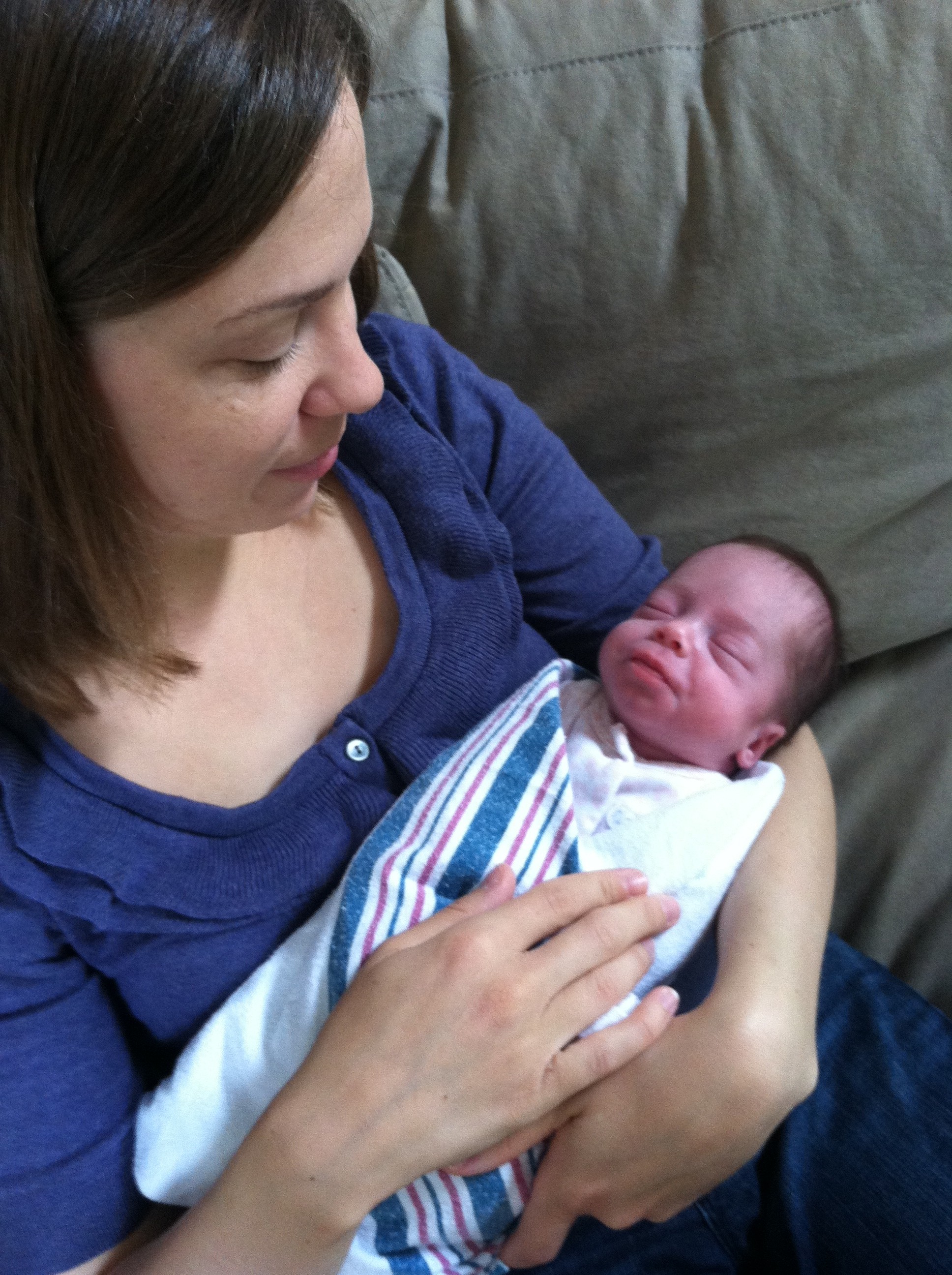
Sarah Erickson, Lexington resident and new mom to Ella Clare, gave birth to her daughter on March 24. Ella Clare was born seven weeks early and weighed 2 pounds 8 ounces.
Erickson had planned a natural childbirth at Augusta Health hospital, about 35 miles away, assisted by one of the four certified nurse-midwifes working for Augusta Health Care for Women. She said she wanted a natural birth but liked knowing that if a complication arose, one of the doctors at the Fishersville hospital could step in.
And a complication did arise. Erickson developed preeclampsia, a serious pregnancy complication where the mother develops high blood pressure and protein buildup in her urine. Augusta Health does not have a neonatal intensive care unit, so a doctor transferred her to the University of Virginia’s unit, where she stayed in the hospital six days before Ella Clare was delivered by cesarean section. Ella Clare stayed in the hospital just over a month, and her parents stayed in the Charlottesville area, 70 miles from Lexington — first at a hotel, then with family and in the Ronald McDonald House — until Ella Clare could come home.
Ella Clare is healthy, happy, and is gaining weight. Her parents are glad that her cheeks are finally getting chubby.
Even though Erickson was considering a natural home birth, she didn’t consider Lexington as an option. She knew that because Carilion Stonewall Jackson Hospital doesn’t have a birthing center, she couldn’t go there for backup medical care.
But what surprised her was how many services, besides a birthing center, actually were in the area for expectant women and new moms.
“There’s a really good network of women here,” she said. She talked to friends who have had babies about what the options here were, and what they liked.
“That helped me figure out that I wanted the midwives,” she said.
Women in the Rockbridge area can find a local midwife, see an obstetrician or gynecologist on three days during the week, and find many pregnancy and parenting education and support classes. For low-income women, the services might be more limited, but the local health department can put them in touch with obstetricians in Charlottesville through telemedicine.
G. Douglas Larsen is health director for the Central Shenandoah Health District. He oversees seven health departments in five Virginia counties. He was also the first obstetrician and gynecologist in Lexington. Before he started practicing in Lexington in 1973, family practitioners delivered babies. He practiced until 1980, when he was hired by the Virginia Department of Health.
Larsen said that 900 to 1,200 babies need to be born a year to financially support a birthing center. There were 305 live births in the Rockbridge area in 2011, according to the Virginia Department of Health.
The hospital’s birthing center closed on April 30, 2010, when the pediatricians in town stopped being able to cover newborns in the nursery. So the area’s main obstetrician left too. Two ob-gyn practices now offer part-time services here, but Larsen said the likelihood of having another full-time birthing center is almost zero.
Another new Lexington mother, Kelsey Goodwin, agreed with Erickson that though the area didn’t have a birthing center, she found the care she needed. She said the area had more midwifery options than she expected—both local and through Augusta Health Care for Women in Fishersville — as well as parenting classes and support groups organized by other moms. She said the community has pulled together to fill in some gaps in care.
But not all the gaps are filled.
Goodwin had to travel to Fishersville for some of her doctor’s appointments. For example, because ultrasounds are available only in Fishersville, she limited herself to two throughout her pregnancy. She said she had no medical need for more, and traveling about 45 minutes both ways meant she had to take whole afternoons off work.
“It’s not conducive to a job,” she said.
She said she knows she’s lucky that she and her husband have transportation, health insurance coverage and paid maternity leave from her job at Washington and Lee University.
For women without insurance, or who may qualify for Medicaid, the Lexington-Rockbridge Health Department can help connect the dots when it comes to prenatal care.
The health department, one of the seven that Larsen oversees, started offering maternity services for women when the hospital closed its birthing center.
“At that time, we didn’t have any provider for maternity services,” said Deborah Allen, family nurse practitioner at the department. “So the health department got together and came up with this plan to help patients that couldn’t travel for maternity care.”
Doctors and nurses at the health department can help pregnant women with their appointments, but new technology is helping the health department meet women’s needs even better. When the delivery center closed, the health department partnered with the University of Virginia to begin offering telemedicine to its patients. The technology allows women to video conference with a labor and delivery doctor in Charlottesville, instead of traveling for appointments.
The technology is designed to be used by women with high-risk pregnancies, but Allen said that most patients use it at some point in their pregnancies. And some patients use it for completely different health care consultations.
This is no ordinary webcam — the screen is so sharp that dermatologists can evaluate potentially cancerous moles, Larsen said.
Women have telemedicine appointments at the office as often as once a week but typically come every other week for most of their pregnancies. The nurses in Lexington help the Charlottesville doctors with the examination by taking the mother’s blood pressure, weighing her and keeping track of her records.
Telemedicine follows the women up to about the 34th week of pregnancy, when they are referred to a hospital for delivery. Most women deliver at UVa’s hospital because they already know their doctor from the telemedicine appointments.
But not all women choose to or are able to travel to Charlottesville.
Allen said that the health department gives patients their records toward the end of their pregnancy in case they deliver someplace else, like Carilion Roanoke Memorial Hospital or Augusta Health in Fishersville.
“UVa is a distance from here,” she said. “So it could be that somebody might not make it that far.”
Allen said her patients feel more secure knowing that an expert is helping. And Larsen said that since the program started in Lexington almost three years ago, the number of premature deliveries has fallen.
Other resources in the area
For more traditional care, Augusta Health Care for Women operates a Lexington office three days a week. LewisGale Physicians staffs two part-time ob-gyns in its Lexington specialty center.
The area also has alternative birth support groups, breastfeeding classes and parenting workshops. Many are listed online. For example, the Rockbridge Midwifery Care website lists 10 local alternative-care groups for mothers that help women who want to give birth to their babies in the area.
Additionally, a newer organization in the Rockbridge area, ComfortCare Women’s Health, offers support specifically for women with unplanned pregnancies.
ComfortCare provides pregnancy confirmation by ultrasound, tests for sexually transmitted infections, medical consultations, abortion counseling and prenatal vitamin packs for mothers. The organization never charges patients, regardless of ability to pay. Most of its patients earn less than $30,000 annually.
“It’s vital to feel empowered,” said Sommer Hansen, president and CEO of the Staunton-based nonprofit.
The Lexington branch of ComfortCare opened in September 2012 and has helped about 30 patients so far, Hansen said. The organization also has centers in Staunton and Waynesboro, and was started in 1983.
